
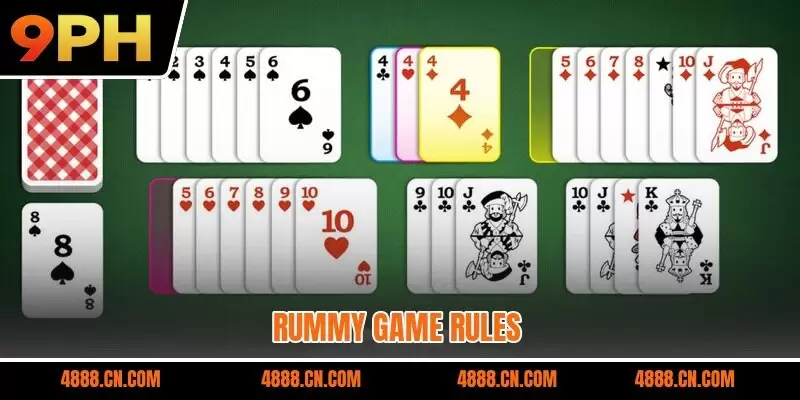
Rummy game rules at 9PH form the foundation of this timeless card game, celebrated for its addictive mix of strategy and luck. Rummy challenges players to stay sharp, read patterns, and make smart decisions based on the cards they draw. Its simple yet strategic nature has led to countless variations enjoyed around the world.
Unique facts about the evolution of rummy game rules
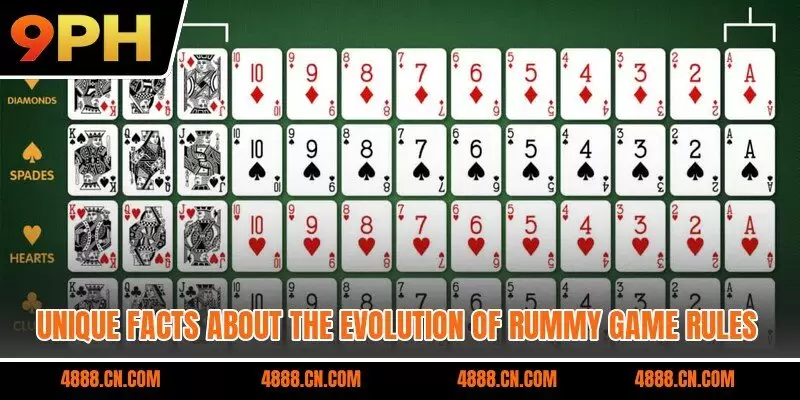
Unique facts about the evolution of rummy game rules
The Rummy family of card games traces its roots to the 19th-century Spanish game Conquian, which introduced the idea of melding cards by rank or sequence. As the game spread globally, variations like Gin Rummy and Indian Rummy emerged, all preserving the core goal of forming valid combinations before the opponent.
Despite small rule differences across versions, the essential rummy game rules of drawing, discarding, and melding stay the same. No matter how many players join, the aim is to minimize unmelded card value, making Rummy a game that blends quick thinking with calculated strategy.
Simple guide to the core rummy game rules and play
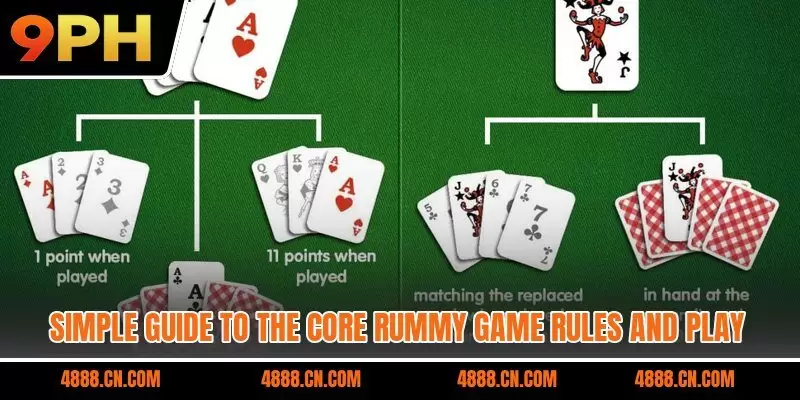
Simple guide to the core rummy game rules and play
The structure of Rummy revolves around drawing and discarding cards in a cyclical manner until one player successfully forms valid combinations and makes a declaration. While various regional rules exist, the following principles apply to most standard versions of the game.
The objective: Declaring a valid hand
The primary goal of the game is to be the first player to form all 13 (in Indian Rummy) or 10 (in Gin Rummy) cards in your hand into valid sets or sequences and then make a declaration. A hand is only valid if it meets specific requirements, which always include at least one “Pure Sequence”.
Defining valid combinations (melds)
The core mechanic of rummy game rules hinges on correctly forming two types of combinations: sequences and sets.
- Series: At least three playing cards in a row, all belonging to the identical suit.
- Pure Sequence: A sequence formed without the use of a Joker or Wild card. This is a required element for an acceptable declaration. (For instance: 4 of Spades, 5 of Spades, 6 of Spades).
- Impure Sequence: A sequence formed using one or more Joker/Wild cards as substitutes. (Example: 4 of Diamonds, Joker, 6 of Diamonds).
- Set (or Life): Three or four cards of the same rank but from different suits. (For instance: a 7 of Hearts, a 7 of Diamonds, and a 7 of Clubs).
The distinction between a Pure Sequence and an Impure Sequence is the most critical element of the foundational game rules. Without at least one Pure Sequence, any declaration made will be deemed invalid, resulting in the maximum penalty score.
Dealing, drawing, and discarding procedures
The standard game is typically played with two decks of 52 cards plus Jokers, especially when four or more players are involved.
- Distribution: Participants receive a set quantity of cards, commonly ten or thirteen, contingent upon the game’s version. The cards left over create the face-down pile known as the Stock.
- Open Deck (Discard Pile): The top card from the Closed Deck is placed face-up to start the Discard Pile.
- The Turn: During a player’s turn, they must perform two actions:
- Draw: The player must draw one card, either from the Closed Deck (Stock) or the top card from the Open Deck (Discard Pile).
- Discard: The player must discard one card, face-up, onto the Open Deck. The number of cards in the player’s hand must remain constant until the final declaration.
| Card Value | Ranks | Point Value (in scoring) |
| High Cards | Ace, King, Queen, Jack | 10 points each |
| Number Cards | 2 through 10 | Point value equals their face value (e.g., 5 is 5 points) |
| Joker/Wild | N/A | 0 points when melded, 0 points if unmelded (in most variants) |
The use of Jokers adds a strategic layer to rummy game rules. A designated Wild Card (chosen randomly at the start) and the printed Jokers can be used to complete Impure Sequences and Sets, significantly aiding the player in forming their combinations.
Making the final declaration
When a player believes they have formed all the required sequences and sets (including the mandatory Pure Sequence), they declare by discarding their final, 14th card (in 13-card Rummy) face down, signifying the end of their turn and the end of the round.
The player then arranges their entire hand on the table for validation by the opponents. If the hand is valid, the round ends, and scoring proceeds based on the points of the unmelded cards held by the losing players.
Unleash your potential with smart rummy game rules tactics

Unleash your potential with smart rummy game rules tactics
To consistently win at Rummy, players must develop a sharp focus on reducing point exposure, utilizing Jokers effectively, and reading the opponent’s discards. These five techniques will transform a novice player into a formidable competitor.
Prioritize the pure sequence immediately
The most crucial strategy in Rummy is to form the Pure Sequence as fast as possible, as this is the mandatory requirement for a valid declaration and significantly reduces your point liability.
Focus on drawing cards that can complete a three-card run without the use of a Joker. Until this is achieved, every other action should be considered secondary, as all other melds are worthless without the Pure Sequence. This adherence to the core rummy game rules prevents maximum penalty scores.
Monitor opponent discards closely
The cards your opponent discards provide invaluable information about their hand and strategy. If an opponent discards a 9 of Diamonds, they are unlikely to be holding a sequence involving the 7, 8, 9, 10 of Diamonds, or a set of 9s.
Use this information to safely discard high-point cards that you suspect your opponent cannot use. Conversely, if they draw from the Discard Pile, identify the rank or suit they are building and avoid discarding useful cards that might enable their declaration.
Discard high-point cards first
Since Aces, Kings, Queens, and Jacks all carry 10 points each, retaining unmelded high-value cards exposes you to a huge penalty if your opponent declares quickly.
A core strategy is to get rid of these high cards early in the game, especially if they are not forming an immediate sequence or set. Always choose to hold lower-value cards (2, 3, 4) unmelded over face cards, as they incur a minimal point penalty.
Utilize jokers defensively and offensively
The Joker or Wild Card is your most valuable asset. Offensively, use it to complete your Impure Sequences and Sets after securing your Pure Sequence. Defensively, be careful not to discard the designated Wild Card itself, as it can be used by an opponent.
A strategic move is to hold onto two potential sequences and use the Joker to complete the one that is hardest to finish naturally, always prioritizing the completion of the mandatory combinations defined by the rummy game rules.
Conclusion
Mastering Rummy at 9PH is a journey of continuous improvement, where strict adherence to rummy game rules is combined with sharp observation and risk management. The game rewards strategic planning, particularly in the rapid formation of the Pure Sequence and the tactical use of Jokers.
 Blackjack 11 – Discover A New Way To Dominate Cards
  Romance Of The Three Kingdoms Leads The 9PH Hero Quest
  Onmyoji Spirits Will Help You Clear The 9PH Dark Zones
  Quick Play Candy – Best 9PH Methods For Lucky Play
  Fruit Party – Guide To A Refreshing Orchard Fortune
  Caishen Riches Bingo – Spin For Your 9PH Golden Bless